Z Image
**Image Prompt (Revised):** The scene is the deck of a small, weather-beaten fishing trawler, the "…
**Image Prompt (Revised):** The scene is the deck of a small, weather-beaten fishing trawler, the "Neptune's Fury," rocking gently against a rustic wooden pier…
Details
- Type
- Z Image
- Dimensions
- 832 × 1216
- Checkpoint
- Z Image Turbo
- Created
- Wait Time
- 27 sec
- Likes
- 1
- Comments
- 0
- Generation Settings
- euler / simple · 9 steps · CFG 0
- Seed
- 1235429616
Prompt
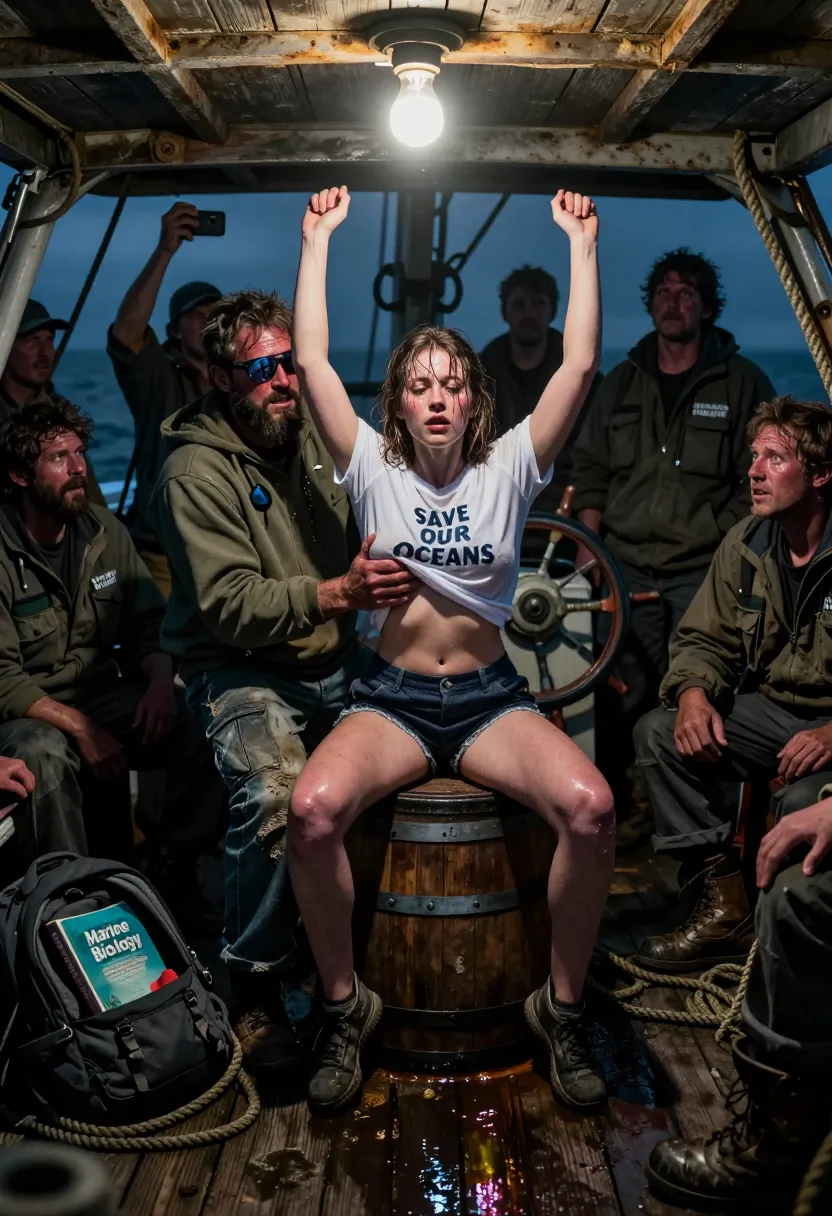
**Image Prompt (Revised):** The scene is the deck of a small, weather-beaten fishing trawler, the "Neptune's Fury," rocking gently against a rustic wooden pier. The lighting is a masterclass in harsh isolation, from a single, unshielded incandescent bulb overhead, its cold, yellow light bleaching the scene while plunging the periphery into deep, shifting shadow. The air is thick with the sharp, briny scent of salt, low tide, and diesel fumes, This is the world of the "Ocean's Vanguard," a ragtag band of self-proclaimed Sea Shepherds, their environmental cause a thin veneer over a raw, macho crew dynamic now in full, ugly bloom. The men are no longer a wall, but a jury. They are seated in a rough circle around the central drama, a mix of grizzled men perched on upturned crates, coils of thick, salt-encrusted rope, and the worn edge of a fish-holding locker. This formation turns the event into a spectacle, a ritual of humiliation performed for an audience. Their faces are turned inward, their leers and flushed, whiskey-reddened features all focused on the center, their bodies creating a confining arena of wood and steel. In the center of this circle, seated on a low, overturned wooden bucket, is the captain. He is a burly, bearded man in his 50s with a weathered face and a missing front tooth. He is sitting on a barrel in the center,In the center of this circle, the raw spectacle has been given a degrading new costume. The captain's hands grip LYDIA's exposed, soft flesh where her tiny, cropped "VANGUARD" tank top has ridden up just under her chest at the lower part of her breasts, one of is hands already under the fabric, the ridden up shirt is revealing the generous curve of her waist and the indent of her navel. She is a vision of youthful, curvy naivete twisted into a object of crude desire. she holds her arms half high forced with elbows a bit bent, (she was just about to higher her arms in a way the captain can undress her, empty hands, Her full, round breasts strain against the thin, white cotton of the top, the cheap print of their logo stretched taut over her chest, the fabric so thin it's nearly translucent. The matching athletic shorts she wears are scandalously short, barely containing the ripe swell of her hips, the hem high on her thighs, offering a generous expanse of her smooth, toned legs. now a jarring, fetishistic adornment on a face made up with flushed, terrified cheeks and trembling, bee-stung lips. She is a caricature of a pin-up girl, dressed for the pleasure of men she thought were her comrades. As the captain forces her to bounce on his lap, the humiliation is sharpened by the knowledge that she chose this outfit—a misguided attempt to fit in, to be one of the "cool" activists—which now makes her look like she asked for this very degradation. Urged on by the captain's hands, Lydia gives a small, terrified hop, a grinding, clumsy parody of a sexual motion. At this cue, the seated men erupt in a deep, mocking chorus of "HO! HO! HO!" The sound is not festive, but predatory, a rhythmic, percussive taunt that echoes in the tight space. the frantic pulse in her neck, a single tear tracing a path through grime. Her nerdy earnestness is being weaponized against her, a sacrifice in the center of their drunken, post-confrontation ring. The cold light catches the stretched, distorted "SAVE OUR OCEANS" logo on her shirt, as well as it captures her perfect breasts in this tight shirt, breasts which are young and natural and seen a bit through because her shirt is a bit wet and she is wearing no bra, a symbol of her cause being defiled with each humiliating bounce, as her backpack, lying open nearby, reveals a well-worn marine biology textbook with the title Marine Biology—a monument to the world from which she has been so violently plucked. The rhythmic mockery grinds on. "HO! HO! HO!" Each chant is a fresh wave of degradation, and with it, the captain's hands tighten, forcing Lydia's motion to become more pronounced, more jarring. The rough denim of his trousers scrapes against the thin fabric of her cargo pants, an intimate, sandpaper friction that sends a jolt of pure revulsion through her. Her muscles burn with the strain of the forced, bouncing motion, a dull ache in her thighs that is the least of her pains. The world has shrunk to the circumference of this circle, to the single, hard point of contact beneath her and the sea of leering faces that surround her. She can feel the heat radiating from the men, their gazes, their lust and mouthwatering mouths, smell the whiskey on their breath, a cloying, sour miasma that replaces the clean salt of the ocean she came here to protect. The man with the phone shifts, getting a better angle. The cold, interrogative light of his camera sweeps over her, pausing on her chest where the captain’s free hand now rests, his thumb stroking the stretched fabric over her breast. "Come on, Lydia," he slurs, his voice a low rumble against her ear that vibrates through her entire body. The lighting is a masterclass in harsh isolation, designed to sharpen the scene's grotesque intimacy. The primary source is that single, unshielded incandescent bulb overhead, its cold, yellow light casting a pitiless, high-contrast glare. It bleaches the top of the captain's head and shoulders, glinting off the salt-crusted steel of the winch beside them, while plunging the lower halves of the onlooking crew into a shifting, semi-obscurity. This creates a tunnel vision effect, forcing the viewer's focus onto Lydia. The light catches the sweat on her temples, the damp frizz of her hair, and makes the olive-green of her hoodie appear sickly and drab against her flushed, pale skin. Deep, distorted shadows pool in the hollows of her throat and beneath the captain's grasping hands, which are knotted in the fabric of her hoodie like claws. Shadows are not empty; they are active participants in the violation. The men encircling them are giants looming in the periphery, . The phone camera held by one of the crew casts a second, more malevolent light source. This portable spotlight captures details the warm dock light misses: the frantic pulse beating in the delicate skin of her neck, a single tear welling and spilling over, tracing a glistening path through the grime on her cheek, and the tiny, frayed threads on her worn cargo pants. *Focus on the tactile details of degradation.* Emphasize the stark contrast in textures. Lydia's soft, slightly oversized hoodie, a garment of comfort, is now being twisted and gripped by the captain's rough, calloused hands. The worn, splintery wood of the deck presses into the soles of her utilitarian but unsuitable sneakers with each forced landing. The rough seam of the captain's denim trousers grates against her inner thighs through the thin material of her pants. The cheap, sticky vinyl of the steering wheel is just behind her, an inert object that witnesses the assault. *Capture the sound as a visual element.* The "HO! HO! HO!" isn't just a sound; it's a physical force. Describe the way the captain's chest vibrates against her back with each grunt from the crew. Show the spit flying from the mouth of the man nearest them as he bellows the phrase, a tiny, glistening droplet caught in the harsh light. The creak of the boat's ropes and the gentle lapping of the water against the hull should feel like a quiet, mocking counterpoint to the human-made cacophony. *Use reflections to fragment the scene.* The captain's sunglasses, tucked into the collar of his sweater, can show a distorted, fish-eye reflection of Lydia's terrified face and the leering circle of men behind her. A small, oil-slick puddle on the deck can reflect a warped, colorful image of the scene, like a corrupted painting. The lens of the phone camera itself, aimed at her, should show a tiny, perfect reflection of Lydia, a miniature portrait of her own victimization being recorded for posterity. *Isolate the symbols of her betrayal.* The "SAVE OUR OCEANS" logo on her hoodie is stretched taut over her chest, the words distorted as the fabric is pulled. The small, enamel dolphin pin she wears on her jacket, a token of her genuine belief, catches the light for a moment, a bright, hopeful symbol drowning in the surrounding filth. Her backpack, lying open near a coil of rope, has a well-worn copy of a marine biology textbook sticking out, its title legible—a monument to the earnest academic world from which she has been so violently plucked. The prompt becomes a crucible where her ideology is not just challenged, but visually and physically defiled.